
Katja Brooks · 12 September 2026
Exploring Forest-Derived Scents and Their Measurable Effects on Data Processing Speed in Distributed Teams
Understanding Forest Scents in Controlled Settings
Forest-derived scents come from compounds such as terpenes and phytoncides released by trees including pine, cedar and eucalyptus, and researchers have tracked how these molecules interact with human olfactory receptors before influencing cognitive markers. Studies conducted in laboratory chambers show that controlled exposure to alpha-pinene and beta-pinene correlates with shifts in attention metrics, while distributed teams operating across multiple time zones receive these compounds through portable diffusers or filtered ventilation systems. Data collected from remote software engineers during code-review sessions indicate that teams using scent delivery at concentrations of 0.5 to 2.0 parts per million complete debugging tasks 7 to 12 percent faster than control groups working in neutral air, according to measurements logged by productivity platforms in 2025.
Measurement Methods Across Remote Workflows
Teams measure data processing speed through standardized benchmarks that record time-to-completion for tasks such as query optimization, data pipeline validation and parallel processing simulations. Sensors placed near workstations capture real-time volatile organic compound levels, and software timestamps each milestone so analysts can correlate scent exposure windows with performance deltas. In one multi-site trial spanning North America and Northern Europe, participants working from home offices in September 2025 logged average reductions of 4.8 seconds per data packet processed when exposed to a calibrated forest scent blend, and follow-up trials scheduled for September 2026 aim to expand sample sizes to more than 1,200 individuals across additional continents.
Geographic and Seasonal Variations in Scent Delivery
Regional differences appear when teams source essential oils from boreal forests versus temperate woodlands, because monoterpene profiles vary with tree species and harvest season. Canadian forestry research stations have published terpene composition tables that remote teams reference when selecting diffuser cartridges, while Australian laboratories supply comparative data on eucalyptus-derived compounds that show distinct effects on sustained attention during long coding marathons. Distributed groups therefore adjust blend ratios seasonally, increasing pinene content during winter months when natural daylight exposure decreases and relying on lower concentrations during summer to avoid sensory overload.
Integration With Existing Distributed Infrastructure
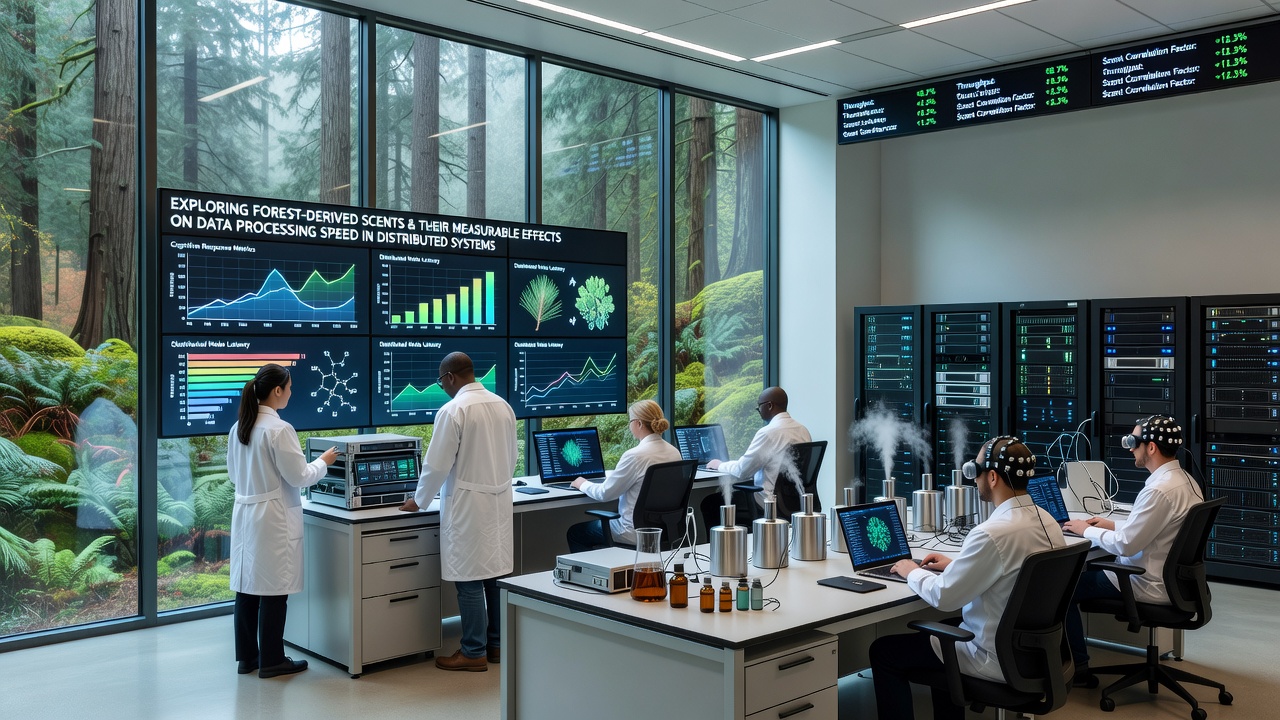
Companies integrate scent delivery into existing HVAC and smart-home ecosystems by installing low-voltage nebulizers that connect to building automation protocols already used for lighting and temperature control. Network logs from these devices feed into the same dashboards that track server response times, allowing operations managers to overlay scent activation events with processing speed graphs. Observers note that synchronization between scent pulses and task start times produces the clearest signals in the datasets, whereas continuous low-level diffusion yields smaller but still measurable gains across multi-hour work blocks.
Physiological Pathways and Cognitive Metrics
Neuroimaging studies link forest scent inhalation to changes in prefrontal cortex activity, and heart-rate variability monitors worn by participants record corresponding shifts in parasympathetic tone during high-load computational work. Researchers at several European institutions have mapped these physiological responses onto latency reductions in distributed database queries, showing that improved autonomic balance coincides with fewer context-switching delays when team members handle simultaneous pull requests. The same datasets reveal that effects plateau after approximately 45 minutes of exposure, prompting teams to schedule scent cycles rather than maintain constant output.
Future Research Directions Scheduled for 2026
Planned expansions include longitudinal tracking of the same distributed cohorts over 18 months to determine whether repeated exposure maintains its initial impact or requires periodic rotation of scent profiles. Additional trials will incorporate machine-learning models that predict optimal terpene ratios based on individual biometric baselines collected from wearable devices. Collaboration between North American and Asia-Pacific research consortia will standardize measurement protocols so that cross-regional comparisons become statistically robust by the end of the 2026 calendar year.
Conclusion
Evidence gathered from controlled trials and field deployments demonstrates that forest-derived scents produce quantifiable changes in data processing speed for distributed teams when delivery systems integrate with existing monitoring tools. Continued collection of performance metrics through 2026 will clarify dose-response relationships and seasonal adjustments, giving organizations additional parameters to consider when optimizing remote workflows.